In a commercial or industrial setting, the water running through your building touches your equipment, your employees, your products, and in many cases, your customers directly. A failing or absent commercial water filter system does not just create a taste problem; it creates scale buildup in pipes, corroded equipment, regulatory exposure, and, in food service or healthcare settings, a real safety risk.
This guide covers everything you need to make an informed decision: how commercial water filter systems work, the types available, how to match a system to your building’s specific needs, what ongoing maintenance looks like, and how Step Saver provides the customized installation, service, and salt delivery that commercial properties need to keep their water treatment running at full effectiveness year after year.
How Commercial Water Filter Systems Work
At their core, all water filtration systems work by passing water through one or more filtration stages, each designed to capture or neutralize specific categories of contaminants. In residential settings, a single filter stage is often enough. In commercial and industrial settings, the volume of water, the variety of contaminants, and the consequences of water-quality failures are significantly greater, which is why most commercial building water filtration systems use multiple stages in sequence, each building on the last.
The general process works like this. Water enters the system and passes first through a pre-filtration stage that removes larger particles, sediment, rust, and debris that would otherwise clog or damage the more specialized stages downstream. From there, water moves through treatment stages targeting specific contaminants: dissolved minerals, chemicals, heavy metals, biological organisms, or some combination of all of these, depending on what the source water analysis reveals. Finally, water exits the system at the quality level required for the building’s specific applications, whether drinking water, process water, boiler feed water, or something else entirely.
The key distinction between a commercial water filter system and a residential one is not just size. Commercial systems are built for continuous operation, higher flow rates, more demanding contaminant profiles, and, in many cases, regulatory compliance requirements that residential systems never face.
The Main Types of Commercial and Industrial Water Filters
Choosing the right filtration approach starts with understanding what each type of system does and what it is designed to remove.
Sediment Filters
Sediment filters are the first line of defense in almost every commercial building’s water filtration system. They remove larger particles, sand, silt, rust, and debris before water reaches more advanced filtration stages. Standard sediment filters handle particles in the 20–40 micron range. Multi-media filters push that to 5–10 microns, offering significantly better protection for downstream equipment and extending the life of every filter stage that follows.
Activated Carbon Filters
Activated carbon removes chlorine, chloramines, volatile organic compounds, bad tastes, and odors through a process called adsorption. Contaminants bind to the carbon surface as water passes through. For restaurants, hotels, and office buildings where drinking water quality matters, activated carbon is a standard part of the filtration sequence. In industrial water filtration applications, large carbon systems backwash periodically on site to extend media life and reduce operating costs.
Water Softeners
Hard water is one of the most damaging and most underestimated problems in commercial buildings. Scale from calcium and magnesium buildup collects inside pipes, on heating elements, inside boilers, in coffee equipment, and in ice machines. Over time, it reduces equipment efficiency, shortens equipment lifespan, and drives up energy costs because scale acts as an insulator, forcing heating systems to work harder to achieve the same output.
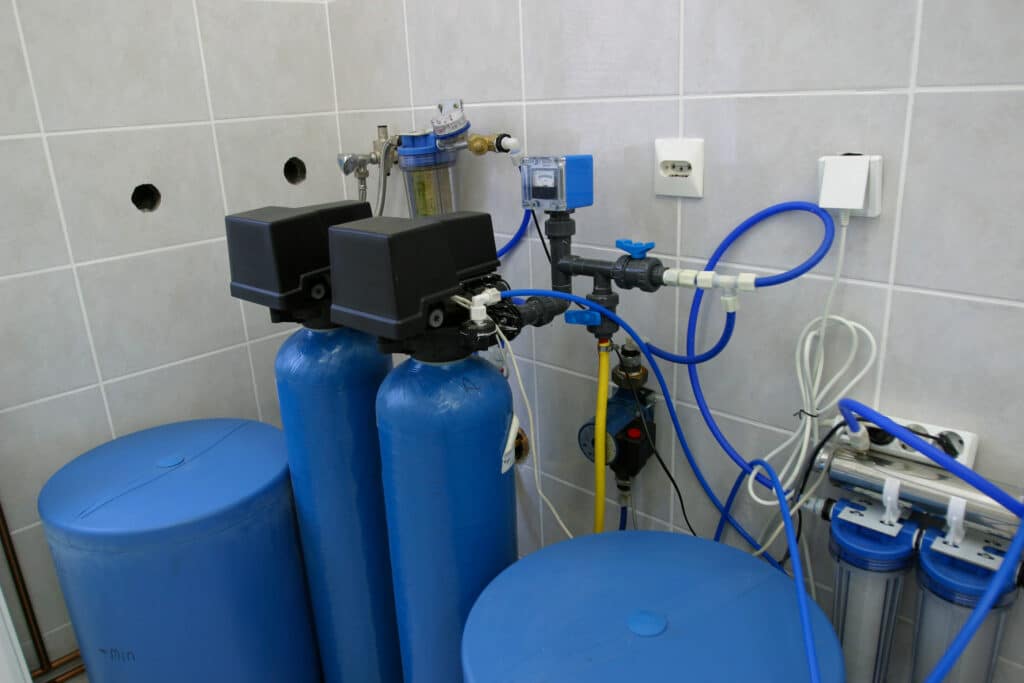
Commercial water softeners use ion exchange to swap calcium and magnesium ions for sodium or potassium ions, effectively eliminating the hardness that causes scale. The benefits are significant and compounding over time. Equipment runs more efficiently. Pipes stay cleaner. Heating elements last longer. Energy bills come down. And the ongoing cost of maintaining the ion exchange resin, through regular salt delivery and replenishment, is a fraction of what unaddressed hard water costs in equipment damage and energy waste year after year.
For high-volume commercial and industrial applications, softening is almost always a foundational part of the water treatment strategy, not an optional consideration.
Reverse Osmosis Systems
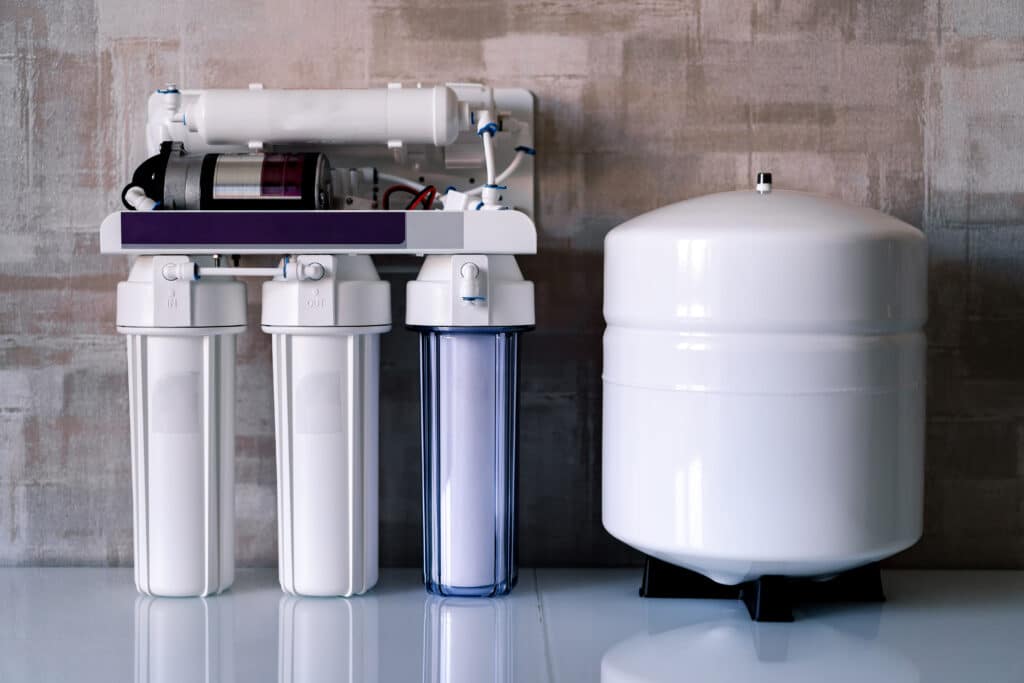
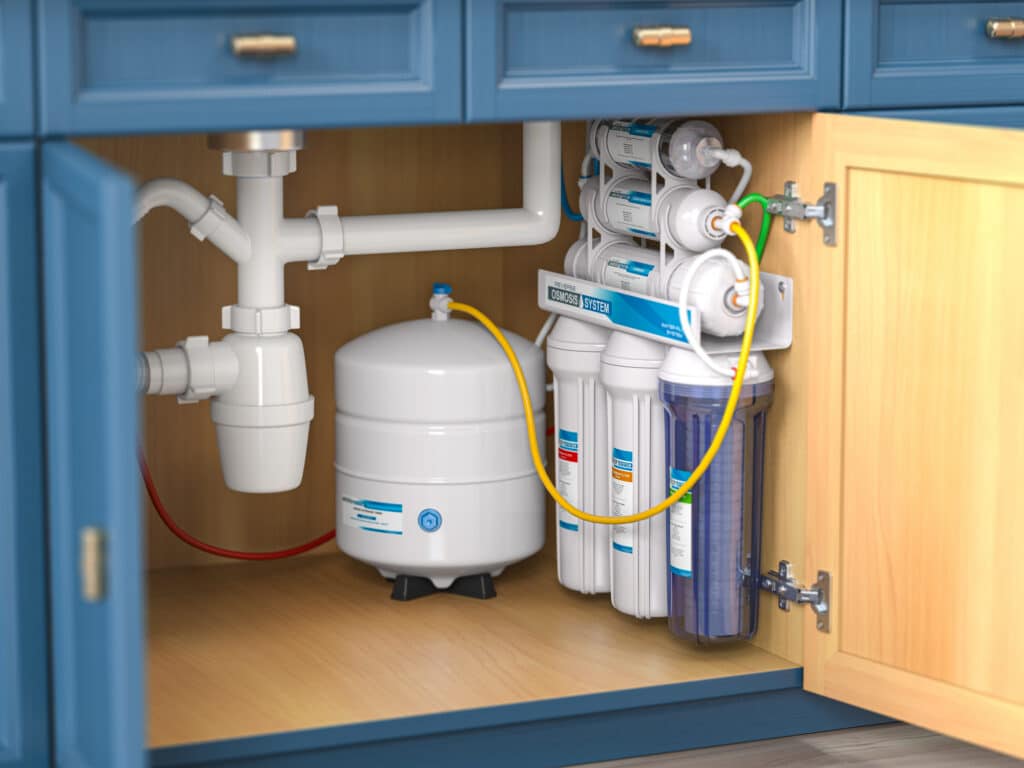
Reverse osmosis is the most thorough commercial water filter method available. It forces water through a semi-permeable membrane under pressure, removing 95% to 98% of dissolved inorganic material, including heavy metals, nitrates, fluoride, bacteria, viruses, and total dissolved solids. The benefits for commercial operations are substantial.
Water treated through an RO system tastes significantly better, which matters directly for restaurants, cafes, hotels, and any business where water quality affects food and beverage quality. Equipment that uses RO-treated water, ice machines, espresso systems, steamers, and boilers lasts longer and requires less maintenance because the dissolved solids that cause corrosion and scaling have been removed before the water ever reaches them. In pharmaceutical, laboratory, and medical settings, RO-grade water is not a preference but a requirement.
RO systems do produce wastewater as a byproduct of the filtration process, and they require membrane replacement and ongoing maintenance to perform consistently. Properly maintained by a qualified service provider, however, an RO system is one of the most reliable and highest-performing investments a commercial building can make in its water infrastructure.
Iron and Manganese Filters
Buildings on well water or in areas with older infrastructure often experience elevated iron or manganese levels. Iron causes reddish staining in fixtures, laundry, and dishware. Manganese produces dark discoloration. Both create taste problems and damage equipment over time. Dedicated iron and manganese filters use oxidation media to convert dissolved metals into filterable particles, and they require periodic regeneration to stay effective.
Ultraviolet Disinfection
UV disinfection inactivates bacteria, viruses, and other pathogens by disrupting their DNA, without introducing any chemicals into the water supply. It is standard in food and beverage production, healthcare facilities, and any industrial water filtering application where biological safety cannot be compromised. Because UV does not remove particles or dissolved solids, it always works in combination with other filtration stages as a final treatment step.
Ultrafiltration Systems
Ultrafiltration uses hollow fiber membranes with pore sizes of 0.01 to 0.05 microns to remove bacteria, viruses, and fine particles without the high operating pressure required by full reverse osmosis. It is well-suited to high-turbidity water sources and large-volume industrial water filtration applications that require thorough particle removal at scale.
Signs Your Commercial Building Needs a Water Filtration System
If any of these sound familiar, it is time to get a water quality assessment:
- Scale or mineral deposits around faucets, inside coffee machines, or in ice makers
- Equipment failing earlier than expected, boilers, water heaters, cooling systems, kitchen appliances
- Water that smells like chlorine, sulfur, or metal, or tastes noticeably off
- Unexplained spikes in energy bills
- Regulatory or compliance pressure in food service, healthcare, or manufacturing
If any of these situations describe your facility, a water treatment assessment is the logical first step.
How to Choose the Right Commercial Water Filter System
Start with a professional water quality test that determines which technologies you actually need. From there, keep these variables in mind:
- Flow rate: Size for peak demand, not average usage
- Contaminant profile: Match the system to your specific water, not a generic solution
- Application: Drinking water, process water, and boiler feed water all have different requirements
- Scalability: Leave room to grow so you are not replacing an undersized system later
The right system, properly sized and consistently maintained, protects equipment, reduces energy costs, and pays for itself many times over.
How Step Saver Supports Commercial Water Treatment from Installation to Ongoing Service
Step Saver works with commercial properties to design, install, and maintain water treatment systems built around each facility’s specific water quality challenges and operational requirements. Rather than offering a catalog of standard systems and leaving businesses to figure out which one fits, Step Saver starts with a thorough assessment of your water supply and your facility’s needs before recommending any equipment.
From there, installation is handled by experienced technicians who understand commercial plumbing requirements, flow rate calculations, and system integration, the details that determine whether a system performs as designed from day one or requires adjustments and troubleshooting after the fact.
Ongoing service keeps systems running at full effectiveness between installations. Filter replacements, membrane inspections, system checks, and performance testing are scheduled, so commercial properties are not left to manage their water treatment reactively. And for facilities with running water softeners, Step Saver’s salt delivery program ensures systems never run low on the salt needed to regenerate, removing one of the most common and preventable causes of softener failure in commercial settings.
If your facility is ready to address its water quality, or if you are not sure where to start, contact Step Saver to schedule a water quality consultation. The right commercial water filter system for your building starts with understanding exactly what your water needs.