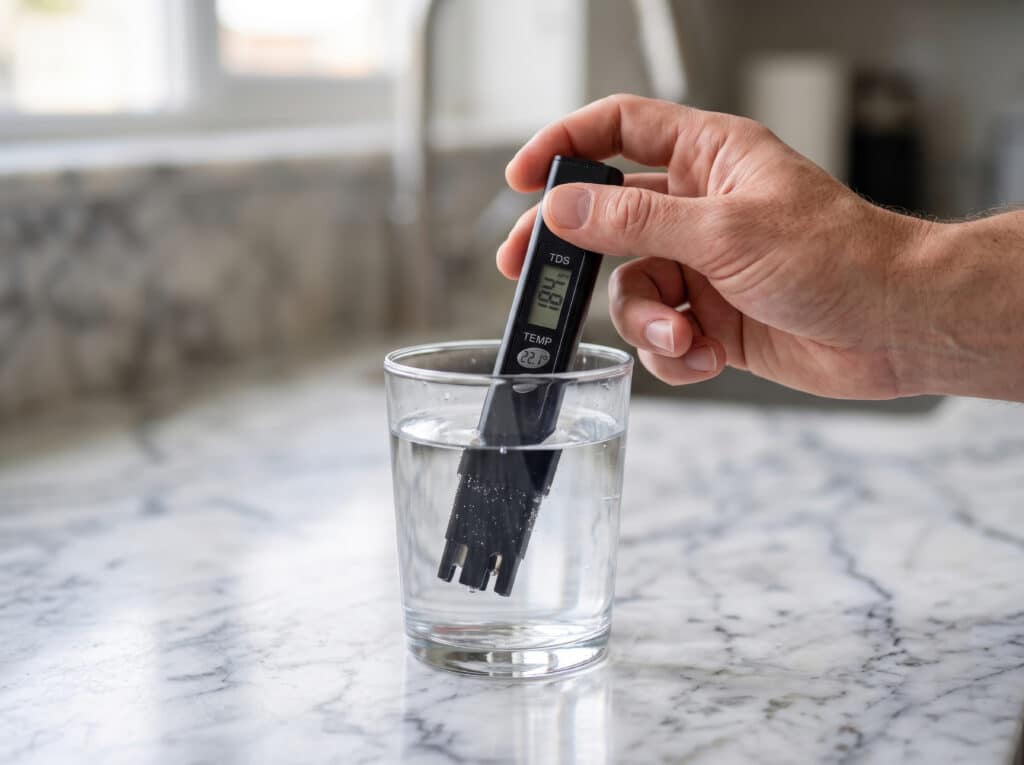
Your dishwasher is leaving film on the glassware. Your boiler is burning more gas than it did last year. The coffee tastes off, and your customers have started mentioning it. Somewhere in the troubleshooting process, someone hands you a little handheld meter; you dip it in a glass of tap water, and it reads 640.
Six hundred forty what? And is that bad?
That number is TDS, and understanding what it measures (and just as importantly, what it does not) is one of the fastest ways to figure out what your water is actually doing to your equipment. Here is what TDS in water means, what a healthy range looks like, how to test for it, and which treatment systems genuinely move the number.
What Is TDS in Water?
TDS stands for total dissolved solids: the combined concentration of every inorganic salt, mineral, and trace amount of organic matter dissolved in a given volume of water. “Dissolved” is the operative word. TDS does not count sand, silt, rust flakes, or anything else you could catch in a filter screen. It counts the material that has broken down into ions and gone invisible.
TDS is reported in milligrams per liter (mg/L) or parts per million (ppm). The two are interchangeable for practical purposes, so a reading of 640 mg/L and 640 ppm means the same thing.
The usual contributors include:
- Cations (positively charged): calcium, magnesium, sodium, potassium
- Anions (negatively charged): bicarbonates, carbonates, chlorides, sulfates, nitrates
- Metals: iron and manganese, which also bring staining and taste problems
- Trace organics: a small fraction of most readings
Here is the part most articles skip: TDS is a total, not a diagnosis. Two facilities can both read 500 ppm and have completely different problems. One might be loaded with calcium and magnesium and scaling up every heat exchanger in the building. The other might be heavy on chlorides and quietly corroding its plumbing from the inside. Same number, opposite failure modes, different equipment.
Where Dissolved Solids Come From
Water is a solvent that dissolves whatever it touches as it travels to your building. Groundwater moving through limestone or halite picks up calcium, magnesium, and sodium chloride, so regional geology sets your baseline. From there, it’s human activity (agricultural runoff, industrial discharge, wastewater, de-icing salt), saltwater intrusion in coastal wells, and dissolved metals from older plumbing, which is why water at your tap can read differently than what the city delivered to your property line. Pollution-driven TDS is the kind worth investigating, since it’s more likely to carry something you genuinely don’t want, like nitrate or arsenic.
What Is a Good TDS Level for Water?
The EPA sets 500 mg/L as a National Secondary Drinking Water Regulation. “Secondary” regulations are aesthetic guidelines covering taste, odor, and appearance, and are not federally enforceable. The EPA does not classify TDS as a health risk on its own.
The World Health Organization’s taste panel ratings give you a more useful scale:
| TDS Level | Palatability Rating |
| Under 300 mg/L | Excellent |
| 300 to 600 mg/L | Good |
| 600 to 900 mg/L | Fair |
| 900 to 1,200 mg/L | Poor |
| Over 1,200 mg/L | Unacceptable |
Very low TDS water tastes flat and empty, which is why some reverse osmosis systems add a remineralization stage. And for commercial use, “palatable” and “equipment-safe” are not the same threshold. Water that tastes perfectly fine at 550 ppm can still be aggressive toward a boiler or a cooling tower, because those systems concentrate dissolved solids as water evaporates. Your 550-ppm feedwater becomes much more concentrated inside the vessel.
How to Test TDS in Water: 3 Strategies
- Handheld TDS meter. The fastest option, and the one most people start with. Here is the mechanical detail competitors rarely explain: a TDS meter does not measure solids at all. It measures electrical conductivity and then multiplies it by a conversion factor (typically 0.5-0.7) to estimate TDS. That is why two meters dipped in the same glass can disagree. It is an estimate, and it is a good one for trending, but it is not a lab result.
- Laboratory analysis. A lab evaporates a measured sample, weighs what remains, and then runs an ion panel that tells you exactly which constituents make up the total. This is the test that turns a number into an action plan.
- Professional water assessment. For a commercial facility, a site evaluation pairs water chemistry with flow rates, usage patterns, and the equipment you are actually trying to protect. The chemistry alone does not size a system.
Use a meter weekly to catch drift, and get a full panel reading annually or whenever the number jumps. A sudden change is a signal that something upstream has shifted.
TDS Test for Hard Water: What It Can and Cannot Tell You
This is where many facility managers get tripped up, so let’s be precise.
Hardness measures only calcium and magnesium, and it is usually reported in grains per gallon (gpg). TDS measures every dissolved substance, including hardness minerals. All hard water contains TDS. Not all high-TDS water is hard.
So, can you use a TDS test to screen for hard water? Partially. A high TDS reading in a region known for mineral-rich groundwater is a strong indication that hardness accounts for a large share of the total, and it is a legitimate reason to investigate further. But the meter cannot distinguish between 400 ppm of calcium carbonate and 400 ppm of sodium chloride, and those two scenarios require completely different equipment.
For reference, 1 gpg equals roughly 17.1 ppm of hardness minerals. If you want a real hardness number, use a titration test kit or a lab panel. Treat the TDS meter as the smoke detector and the hardness test as the actual inspection. If you are seeing scale, spotting, and soap that will not lather, our breakdown of the most common issues caused by hard water covers what to look for.
Signs TDS Is Costing Your Facility Money
- Scale on heating elements, inside pipes, and across heat exchangers, which throttles flow and forces equipment to work harder for the same output
- Corrosion in distribution piping and vessels, driven largely by the chloride and sulfate share of the total
- Spotting and streaking on glassware, dishware, and vehicles in car wash operations
- Taste complaints in coffee, ice, and beverage service, where chloride reads salty and sulfate reads bitter
- Chemical overuse, because detergents and soaps lather poorly and get burned through faster
- Linen and uniform wear in laundry operations, where mineral abrasion shortens fabric life
- Shorter equipment lifespan across water heaters, ice machines, dish machines, and boilers
Does a Water Softener Reduce TDS?
Honest answer: not meaningfully, and anyone telling you otherwise is selling you the wrong system.
A softener works by ion exchange. Hard water passes through a resin bed; the resin captures calcium and magnesium ions and releases sodium ions in their place. The hardness minerals leave. But something was swapped in for them, so your total dissolved solids reading stays roughly where it started.
That does not make a softener optional. It makes it the right tool for a different job, and usually the more urgent one:
- It stops scaling. Calcium and magnesium are the fraction of your TDS that builds deposits on heat transfer surfaces. Remove those, and the scaling stops even though the total barely moves.
- It protects your RO investment. Hardness is the fastest way to foul and destroy a reverse osmosis membrane. A properly sized softener installed ahead of an RO unit extends membrane life and keeps the system hitting its rejection spec.
- It immediately improves daily operations. Better lather, less chemical consumption, cleaner glassware, longer-lasting linens.
If you want the full mechanics of ion exchange, regeneration, and brine cycles, start with our beginner’s guide to water softeners.
How to Actually Lower TDS
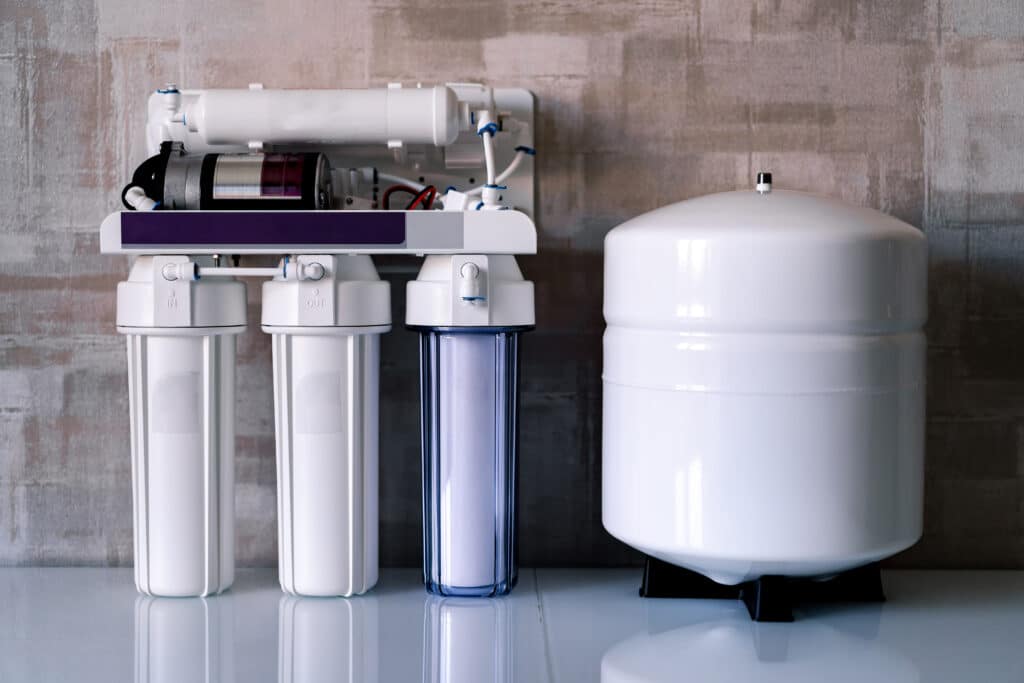
Reverse osmosis is the primary answer. RO forces water through a semi-permeable membrane under pressure, rejecting the large majority of dissolved inorganic material, including salts, metals, nitrates, and fluoride. For commercial operations that need low-TDS water for spot-free rinsing, beverage programs, boiler feed, or production processes, RO is the workhorse. Many systems offer a remineralization cartridge to restore taste to water destined for drinking.
Deionization goes further for applications where even trace ions cause problems, such as laboratory and precision manufacturing work.
Blending mixes RO permeate with softened water to hit a target TDS rather than driving it as low as possible, which keeps operating cost and water use down when ultra-pure is overkill.
Two things that do not work: boiling and standard sediment filtration. Boiling removes some volatile compounds but leaves dissolved solids behind, and because water escapes as steam, it actually concentrates them slightly. A sediment filter catches suspended particles, not dissolved ones.
TDS in Water FAQs
Is high TDS water safe to drink?
Usually, yes. TDS is regulated as an aesthetic concern, not a health one. But because a high reading can indicate contaminants like nitrate, sulfate, or arsenic, elevated TDS is a good reason to run a full panel rather than assume everything is fine.
What is the ideal TDS level for drinking water?
Rates under 300 mg/L are considered excellent for taste, and the EPA guideline is 500 mg/L. Extremely low readings taste flat, so lower is not automatically better.
Can a water softener reduce TDS?
No, not significantly. It exchanges calcium and magnesium for sodium, which eliminates hardness and scaling while leaving the total roughly unchanged. Reverse osmosis is the system that lowers TDS.
Does a TDS meter measure water hardness?
No. It estimates all dissolved solids via conductivity. Hardness is a separate measurement of calcium and magnesium only, and it requires a titration kit or a lab test.
How often should a commercial facility test TDS?
Weekly spot checks with a meter to catch drift, plus a full laboratory panel annually or any time the reading moves sharply.
Build the System Around Your Water, Not Around a Number
The right configuration almost always starts with a full water panel, not a handheld reading. A facility heavy on hardness needs softening with RO sized for its specific low-TDS applications. A facility heavy on chlorides needs a corrosion-focused approach. Sizing depends on the hardness load, flow rate, duty cycle, and room for growth.
Step Saver designs, installs, and services commercial water softeners and reverse osmosis systems for restaurants, car washes, hotels, manufacturing facilities, and medical offices. That includes proper sizing up front, ongoing service, and a salt delivery program that keeps softeners from quietly failing because a brine tank runs empty. Contact our team to get a water treatment solution that works for your business.