
You’ve probably seen the phrase on a water bottle label, a kitchen filter ad, or a plumber’s spec sheet. But what is reverse osmosis, really? What does it actually do to your water, and why do so many homes, restaurants, car washes, and industrial facilities rely on it?
This guide answers all of that, explaining reverse osmosis water technology, how it works, what it removes, and whether it makes sense for you.
A Breakdown of Regular Osmosis
To understand what a reverse osmosis process is, it helps to understand osmosis first.
Osmosis happens naturally all the time. When two liquids with different concentrations are separated by a semipermeable membrane (a thin barrier engineered with microscopic pores), water moves from the less concentrated side to the more concentrated side. It’s the body’s way of balancing things out. Your cells do it constantly.
Now flip that process. Apply pressure to the more concentrated side, and you force the water to move in the opposite direction, through the membrane, leaving the contaminants behind. That’s reverse osmosis. You’re using pressure to push clean water away from everything that shouldn’t be in it.
What Is a Reverse Osmosis System?
A reverse osmosis system is a water filtration setup that uses this membrane process, typically combined with a few additional filter stages, to produce exceptionally clean water.
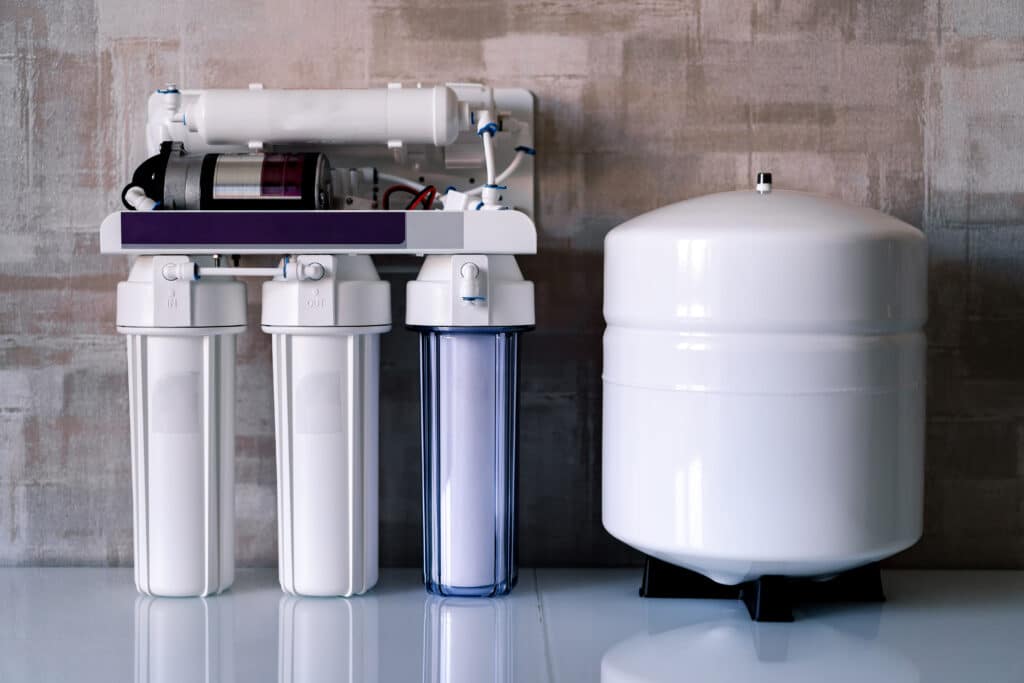
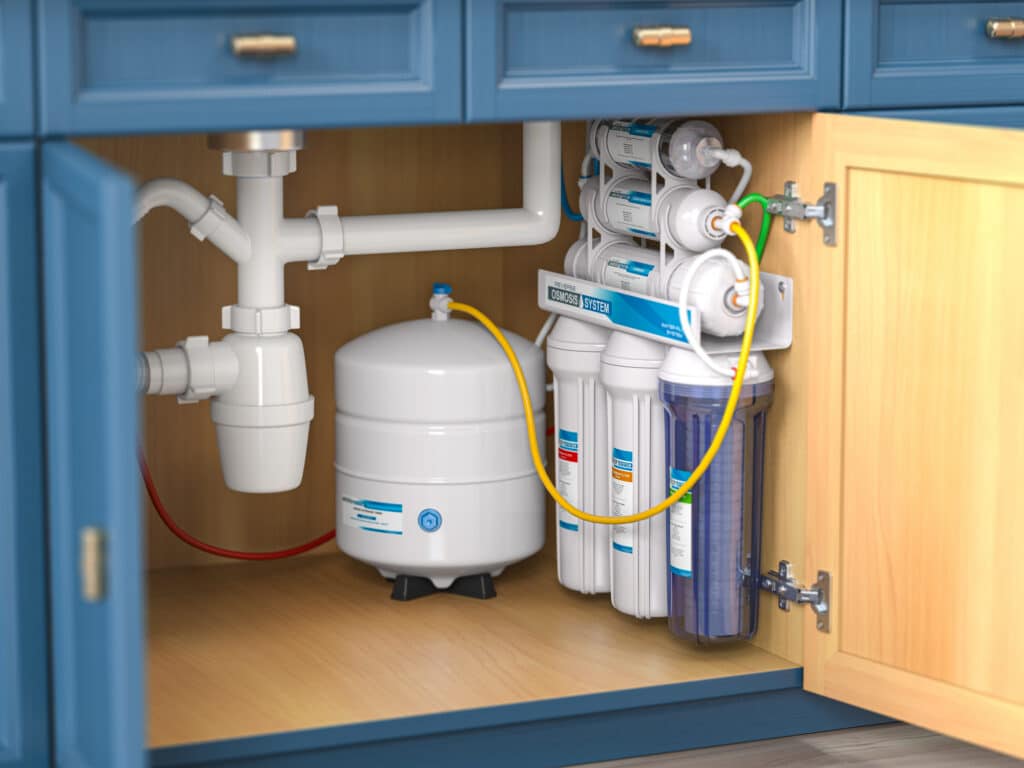
Here’s what a standard reverse osmosis water filter system looks like in practice:
Stage 1 — Sediment Pre-Filter: Water first passes through a pre-filter that captures visible particles, such as dirt, rust, sand, and larger particles. This protects the membrane and extends its life.
Stage 2 — Carbon Pre-Filter: A carbon filter handles chlorine, chloramines, and some organic compounds that could otherwise degrade the membrane. It also starts improving taste and odor at this stage.
Stage 3 — The RO Membrane: This is the heart of the system. The semi-permeable membrane has pores so small — roughly 0.0001 microns — that only water molecules pass through. Nearly everything else gets rejected and flushed down the drain.
Stage 4 — Post-Carbon Filter: A final carbon polish removes any lingering taste or odor before the water reaches your glass.
Many systems also include a storage tank, since membranes produce filtered water slowly. Under-sink systems typically store 2–4 gallons, ready for on-demand use.
That’s what a reverse osmosis water system is at its core, a reliable, chemical-free filtration process designed to deliver consistent water quality across commercial and residential applications alike.
What Is Reverse Osmosis Water?
What is reverse osmosis water, exactly—is it just “really filtered” tap water?
The distinction lies in the degree of filtration. What is reverse osmosis purified water measured against regular tap water? It comes down to TDS, Total Dissolved Solids, measured in parts per million (ppm). Typical tap water runs 150–500 ppm, depending on where you live. Reverse osmosis water typically lands at 10–50 ppm. That’s a dramatic reduction you can actually taste.
Worth noting: the process removes some beneficial minerals like calcium and magnesium along with the bad stuff. This is why many reverse osmosis drinking water system setups include a remineralization filter at the end, adding those minerals back in balanced amounts. The result is water that tastes clean and fresh, not flat or hollow.
What Does Reverse Osmosis Remove?
This is where things get genuinely impressive. Reverse osmosis water filtration can remove contaminants, including lead, volatile organic compounds (VOCs), PFAS, arsenic, bacteria, and viruses, according to the U.S. Environmental Protection Agency.
Here’s a broader look at what reverse osmosis removes:
- Lead — one of the most serious tap water concerns, especially in older homes with aging pipes
- PFAS (“forever chemicals”) — the EPA has identified reverse osmosis as one of the Best Available Technologies for meeting PFAS Maximum Contaminant Levels
- Arsenic — a naturally occurring element that shows up in many municipal and well water sources
- Nitrates — particularly relevant in agricultural areas where fertilizer runoff reaches groundwater
- Chlorine and chloramines — responsible for that harsh taste and smell in tap water
- Dissolved salts and heavy metals — including mercury, barium, and chromium
- Microplastics — increasingly found in water sources worldwide
- Bacteria and some viruses — physically blocked by the membrane’s ultra-fine pore
The Environmental Working Group notes that reverse osmosis also reduces perchlorate, which affects thyroid function, and nitrate, which can be immediately toxic to infants at higher concentrations.
What reverse osmosis water doesn’t remove in meaningful quantities: dissolved gases, and some pesticides with very small molecular sizes. This is why multi-stage systems pair the membrane with carbon pre- and post-filters—together, they cover the full spectrum.
Is Reverse Osmosis Water the Same as Distilled Water?
The difference between reverse osmosis water purification and distillation comes down to method. Distillation boils water and collects the steam. Reverse osmosis pushes water through a membrane using pressure. No heat, no waiting, no energy-heavy process. For everyday home and commercial use, RO is far more practical.
When comparing a reverse osmosis system to a standard pitcher filter, the two are not in the same category. A pitcher filter softens some taste issues. A reverse osmosis system removes up to 99% of hundreds of contaminants at the molecular level.
Where Is Reverse Osmosis Technology Used?
Reverse osmosis technology isn’t just a home kitchen upgrade; it’s a workhorse across a wide range of industries.
Residential: Under-sink and countertop units provide households with clean, reverse-osmosis drinking water for cooking and drinking, without relying on bottled water.
Commercial Food Service: Restaurants and coffee shops use RO water to improve flavor consistency—the minerals and chlorine in tap water can noticeably affect the taste of coffee, tea, soups, and sauces.
Car Washes: This one surprises people. Spot-free rinse systems in professional car washes rely on ultra-pure RO water. Dissolved minerals in tap water leave spots and streaks on vehicle surfaces as the water evaporates. RO-treated water dries clean. It’s one of the most impactful operational upgrades a car wash can make.
- Read more about how reverse osmosis works in car wash applications and why it matters for your business.
Manufacturing and Industrial: Semiconductor production, pharmaceutical manufacturing, boiler systems, and food processing all require water that meets strict purity standards. A well-designed commercial reverse osmosis system delivers that reliability at scale.
Healthcare: Hospitals use RO water in dialysis equipment, sterilization, and laboratory applications where contaminant levels must be tightly controlled.
How Much Water Does a Reverse Osmosis System Use?
This is a fair question. The membrane filtration process produces some wastewater, the concentrated reject stream that carries the removed contaminants. A typical point-of-use RO system generates five gallons or more of reject water for every gallon of treated water produced, according to the EPA.
Modern systems have improved significantly on this ratio. High-efficiency models can achieve 1:1 ratios or even better. Permeate pumps and zero-waste designs are increasingly common in newer residential units.
For commercial operations processing large volumes, system design matters even more. That’s where working with an experienced installation team pays off—a well-configured system minimizes waste without compromising output quality.
What is A Reverse Osmosis Water Filter? Is It the Right Fit for You?
A reverse osmosis filter is worth serious consideration if:
- Your tap water has a noticeable taste, smell, or cloudiness
- You live in an area with known contamination issues—lead, nitrates, PFAS, arsenic
- You are dealing with hard water conditions where dissolved minerals are causing scale buildup, spotting, or equipment degradation
- You have young children or immunocompromised family members at home
- You use a private well with limited municipal oversight
- You run a business where water quality directly affects your product or service
It’s less essential if you’re already on a municipal system with excellent water quality reports and no specific contaminant concerns, though many people still prefer the peace of mind and taste improvement.
Getting Started with Reverse Osmosis
Step Saver specializes in commercial water treatment, serving businesses, car washes, food service operations, and industrial facilities that require professionally installed, high-performance systems.
From single-unit installations to large-scale commercial reverse osmosis installation & repair, our team brings the expertise to design, install, and maintain systems built for consistent, long-term performance.
Ready to find the right fit for your operation? Get in touch to discuss your water quality, usage volume, and installation requirements. The right system starts with the right conversation.