You checked the brine tank, and it’s empty. Maybe it’s been empty for a while, and you didn’t notice until the water started feeling different. Either way, you’re wondering how bad the situation actually is and what you need to do next.
The short answer: it’s fixable, but the longer your system runs with no salt in the water softener, the more you’ll feel the effects throughout your building or home. Here’s exactly what’s happening, what to watch for, and how to get things back on track.
What Happens If Your Water Softener Runs Out of Salt
To understand what happens when a water softener runs out of salt, it helps to know what salt actually does. Your softener works through a process called ion exchange. Resin beads inside the tank grab calcium and magnesium ions (the minerals that make water “hard”) and release sodium ions in return. Salt is what recharges those resin beads during the regeneration cycle.
When the salt runs out, the resin beads stop getting recharged. They become saturated with hardness minerals and lose their ability to soften the water. At that point, hard water starts flowing straight through your system as if the softener weren’t there.
This doesn’t happen instantly. Most systems have enough residual capacity in the resin to keep softening for a short period after the brine tank empties, anywhere from a few days to a week or two, depending on your usage and system size. But once that capacity is exhausted, untreated hard water is going through every faucet, appliance, and pipe in the building.
5 Signs Your Water Softener Ran Out of Salt
If you didn’t catch the empty tank early, your water will start telling you. Here’s what to look for when a water softener runs out of salt:
1. Soap and shampoo stop lathering the way they should.
Hard water interferes with how soap and detergent interact with water. Staff will notice it takes more product to get the same results in dishwashing, laundry, or cleaning operations, and the lather feels thin or sticky.
2. Spots on dishes, glasses, and fixtures.
Those white, chalky spots on glassware and stainless steel surfaces are calcium and magnesium deposits left behind as water evaporates. In restaurants, hotels, and foodservice operations, this is often the first visible sign that something’s off, and it’s noticeable to customers.
3. Scale buildup around faucets and showerheads.
The same minerals that leave spots on dishes will start accumulating around fixtures and water-using equipment. In hard water areas, this can become visible within days and accelerate wear on commercial-grade fixtures.
4. Skin and hair feel different.
Hard water increases strain on water heaters, boilers, and any equipment that relies on consistent water quality. This often shows up as higher energy costs before it shows up as a visible problem.
5. Water pressure drops over time.
This one takes longer to develop, but hard water scale inside pipes narrows the flow path over time. For commercial facilities running high water volume, reduced pressure can directly affect operations. If your system has been out of salt for an extended period, this is a sign that the problem has been building.
What Happens If You Stop Putting Salt in the Water Softener Long-Term
A few days without salt is inconvenient. Months without salt are a problem entirely different.
Water heaters are particularly vulnerable. Hard water scale inside a water heater forces the unit to work harder to heat the same volume of water, driving up energy costs and shortening the equipment’s lifespan. A study by the Water Quality Association, commissioned through its research arm known as the Water Quality Research Foundation, found that water heaters operating on hard water can lose up to 48% of their efficiency and reach the end of their useful life years earlier than softened water counterparts.
Commercial operations feel this even more acutely. Foodservice equipment, boilers, cooling towers, and any water-using machinery in a facility are all susceptible to the scale accumulation that comes with water softener out of salt situations. The cost of descaling, repairing, or replacing commercial equipment dwarfs the cost of consistent salt delivery.
The resin beads themselves can also be affected by extended hard water exposure. While resin is generally durable, heavily fouled beads may not regenerate fully even after salt is restored, which can reduce the system’s softening capacity until the resin is cleaned or replaced.
What Happens When a Water Softener Runs Out of Salt: Step-by-Step
Here’s the practical sequence of events after the brine tank empties:
Days 1–7 (approximately): The resin still has some softening capacity. Water quality may start to decline slightly, but the change might not be obvious yet.
Week 2 onward: Resin capacity is exhausted. Hard water is flowing through the system. Spotting on dishes and fixtures begins. Soap performance drops noticeably.
Month 1+: Scale starts accumulating in water heaters, appliances, and pipes. Energy efficiency drops. If this is a commercial facility, equipment strain becomes measurable.
Month 3+: Significant scale buildup in pipes and appliances. Water heater efficiency is substantially reduced. Resin may need professional attention before the softener returns to full capacity.
The takeaway is clear: catching an empty brine tank quickly limits the damage to a few days of hard water inconvenience. Letting it go means paying for it in other ways.
What to Do When Your Water Softener Runs Out of Salt
Step 1: Add salt to the brine tank immediately.
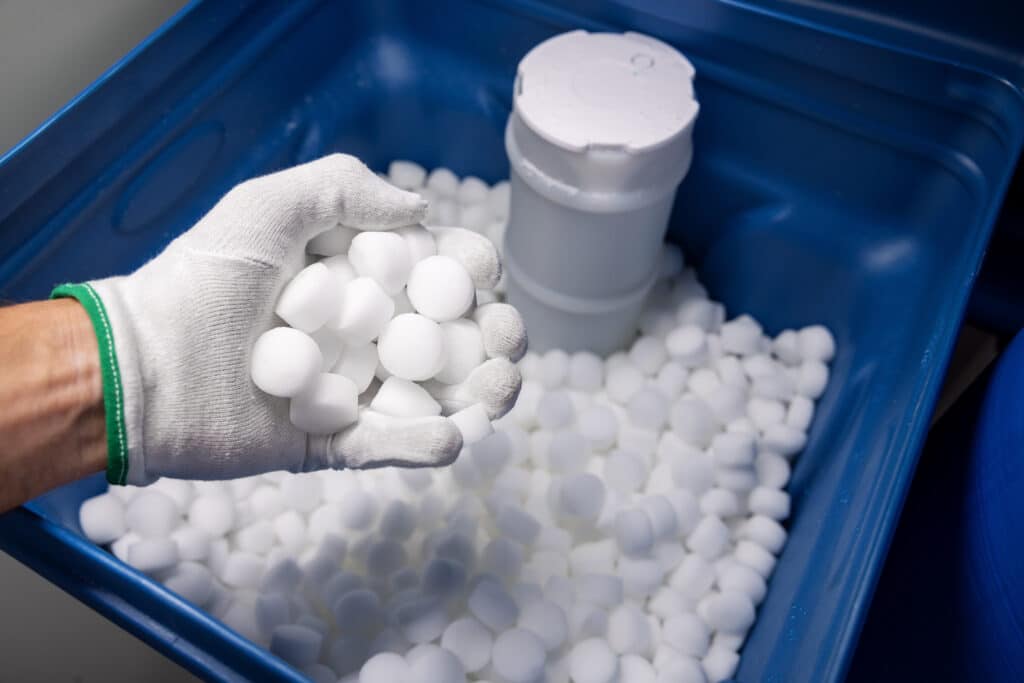
Open the brine tank and check the salt level. If it’s low or empty, add the right type and amount of salt before doing anything else. Don’t overfill; leave a few inches from the top to allow for proper brine formation.
Step 2: Manually trigger a regeneration cycle.
Don’t wait for the next scheduled regeneration. Most systems have a manual regeneration option; check your unit’s manual for how to initiate it. This forces the system to use fresh brine to recharge the resin beads immediately. After the cycle completes, your softener should be back to treating water effectively.
Step 3: Check for salt bridges or mushing.
If the tank looked like it had salt but wasn’t actually softening water, you may have a salt bridge, a hardened crust of salt that forms across the top of the tank, leaving empty space below it. Press down on the salt with a broom handle or similar tool. If it’s hollow underneath, break up the bridge and let the loose salt settle before triggering regeneration. Salt mushing (a thick, sludgy layer at the bottom) is a related issue that requires the tank to be cleaned out before refilling.
Step 4: Set a refill schedule.
A one-time empty tank is easy to recover from. Repeated depletion is a maintenance problem. How often you need to add salt depends on your water hardness, system size, and usage volume —but the answer is almost always “more regularly than most people think.” And how much salt to use matters too —underfilling leaves you vulnerable to the same problem again, while overfilling can cause its own issues.
Why Commercial Operations Can’t Afford to Run Out of Salt
For a residential household, running out of water-softener salt for a week is inconvenient. For a commercial operation —a hotel, restaurant, laundry facility, car wash, or manufacturing plant —it’s a cost center.
Hard water scale in commercial equipment is expensive to remove and even more expensive to ignore. A descaling service for a commercial water heater or boiler costs hundreds to thousands of dollars. Equipment that fails prematurely due to scale buildup costs more. Lost productivity during repairs or replacements costs more still.
The most practical solution for commercial operations is to remove salt restocking from the to-do list entirely. Step Saver’s commercial salt delivery services include bagless automatic mini-bulk delivery; our team pumps metered, NSF-certified salt directly into your brine tanks on a scheduled basis using patented equipment. You don’t check tanks, you don’t order bags, and you don’t run out.
For facilities that need a full equipment review after extended exposure to hard water, our commercial water softener installation and repair team can assess resin condition, clean or replace components as needed, and restore the system to full operating capacity.
The Bottom Line on Running Out of Water Softener Salt
The answer to what happens if your water softener runs out of salt is simple: hard water comes back, and everything hard water does to your pipes, appliances, fixtures, and skin comes right back with it. The longer the system runs without salt, the more compounds are formed.
Add salt as soon as you notice the tank is low, trigger a manual regeneration, and set up a schedule so you’re not in this position again. If you’d rather not think about it at all, contact Step Saver. We’ll handle the salt so you can focus on everything else.