If your clients are walking out of your salon, spa, or gym with dull, brittle hair, or complaining that their scalp feels dry and irritated after every visit, the problem might not be your products. It might be your water.
Hard water is one of the most overlooked factors in hair and skin health, both for individuals at home and for businesses that provide water-related services. Understanding what hard water actually does to hair, where the science stands, and what you can do about it is especially important for commercial facilities like salons, spas, gyms, and hotels, where dozens or hundreds of people wash their hair every day.
What Is Hard Water and Why Does It Matter?
Hard water is water that contains elevated concentrations of dissolved minerals, primarily calcium and magnesium, that it picks up naturally as it moves through rock and soil. The minerals themselves are not harmful to drink. The problem is what they do over time when they come into contact with your hair, scalp, skin, and plumbing.
You can usually recognize hard water by the white, chalky deposits it leaves around faucets and showerheads, the way soap struggles to lather, and the filmy residue it leaves on surfaces after drying. Those same mineral deposits are landing on your clients’ hair and scalp every time they wash under your showers.
Does Hard Water Cause Hair Loss? What the Research Actually Says
This is the question people search for most, and the honest answer is more nuanced than a simple yes-or-no.
Hard water does not cause follicular hair loss, the kind of permanent, pattern-based loss driven by genetics, hormones, or medical conditions. The research does not support that. What hard water does cause, consistently and measurably, is hair shaft damage, increased breakage, and the kind of cumulative buildup that makes healthy hair growth harder to sustain over time.
A companion scanning electron microscopy study published in the International Journal of Dermatology found that hair samples washed with hard water over 30 days showed visible surface changes under the microscope compared to distilled water samples, including mineral deposits along the hair shaft that were not present in the control group.
How does hard water cause hair loss, or at least the appearance of it? The mechanism is straightforward. Calcium and magnesium ions in hard water form a mineral film on the hair shaft and scalp with every wash. Over time, this film:
- Roughens the hair cuticle, causing frizz, dullness, and tangles
- Prevents moisture from penetrating the hair shaft, leading to chronic dryness
- Interferes with how shampoo and conditioner work, leaving residue behind even after rinsing
- Raises the scalp’s surface pH, disrupting its natural acid mantle and making it more reactive and irritated
- Blocks follicle openings, reducing the flow of nutrients that support healthy hair growth
The result is hair that is consistently weaker, drier, harder to manage, and increasingly prone to breaking during everyday handling, brushing, towel drying, and heat styling. For clients who already have scalp conditions such as eczema, psoriasis, or seborrheic dermatitis, hard water mineral residue can aggravate these conditions, making the scalp more inflamed and the hair-loss picture more complicated.
As Dr. Patrick Angelos, author of The Science and Art of Hair Restoration, has noted, hair loss can occur when hard water severely affects the scalp, particularly in people with existing scalp conditions. Healthline has reported similar findings from hair care experts, noting that when hair is difficult to work with due to mineral buildup, it increases overall stress on the hair shaft.
Does Drinking Hard Water Cause Hair Loss?
No, not directly. The minerals in hard water are not harmful at the concentrations typically found in drinking water, and consuming them does not affect hair follicles or hair growth cycles in any clinically meaningful way. The effects of hard water on hair are topical, not systemic. They come from direct contact with the scalp and hair shaft, not from ingestion.
If you are concerned about water quality from a drinking standpoint, that is a separate conversation, one about filtration rather than softening. But for hair health in commercial settings, the problem lies in topical exposure during washing, and the solution needs to be focused there.
Why This Matters More in Commercial Settings
For a homeowner, hard water is an inconvenience. For a salon, spa, gym, or hospitality facility, it’s a business problem. Does hard water cause hair loss for the dozens of clients cycling through your showers each week? Not directly, but it does create the kind of cumulative damage that shows up in every result your business delivers.
Consider how many clients wash their hair in your showers over the course of a week. Each wash deposits another layer of mineral film on the scalp and hair shaft. The products your staff applies, color treatments, conditioning treatments, scalp services, are all working against a mineral barrier that reduces their effectiveness. Clients may not connect their dry scalp or lackluster hair to your facility’s water supply, but over time, the results they experience under your care are shaped by it.
There are several specific ways hard water creates problems for commercial water-related businesses:
Salons and hair care facilities: Hard water interferes directly with chemical services. Color treatments, perms, and keratin treatments all perform differently, and often worse, when the hair has significant mineral buildup. As hairstylist and salon owner Mara Roszak told Healthline, hard water makes hair difficult to work with, which increases overall stress on hair. That is a quality problem that reflects on the facility, not the stylist.
Spas and wellness facilities: Clients come to a spa for restoration. Hard water working against their scalp’s moisture barrier and leaving mineral residue after every service directly undermines that experience. Scalp treatments, deep conditioning services, and any water-based therapeutic service all deliver better results on a clean, mineral-free canvas.
Gyms and athletic facilities: Members who shower at the gym are washing their hair in your water every day. Hard water exposure of that frequency and regularity is exactly the kind of sustained, cumulative mineral exposure that produces the most visible damage over time. Members who notice their hair quality declining during a period when they are showering more frequently may not realize that the water is the variable that has changed.
Hotels and hospitality: Guests have no control over the water they shower in during their stay. Hard water that leaves hair feeling flat, dry, and unmanageable is a legitimate guest experience issue, particularly at properties that position themselves around wellness, luxury, or rejuvenation.
The Commercial Water Softener Solution
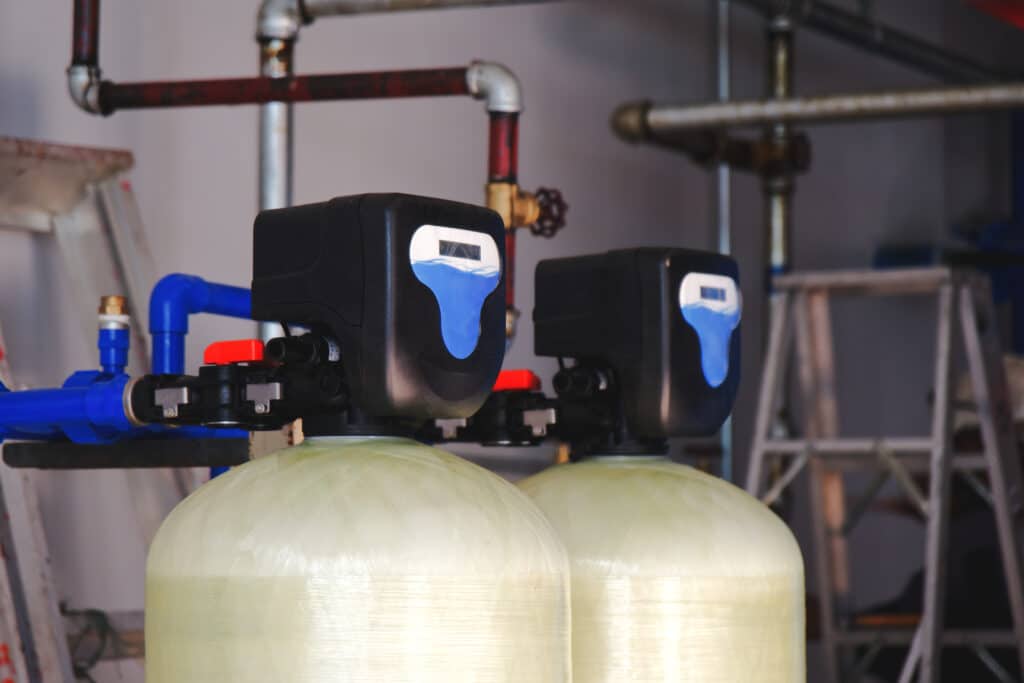
The most effective long-term solution for businesses dealing with hard water is professional commercial water softener installation and repair. Unlike shower filters or clarifying shampoos, which address the symptoms temporarily, a commercial water softener treats the water at the source before it ever reaches your showers, sinks, or treatment rooms.
Commercial water softeners work through a process called ion exchange. Hard water passes through a resin bed, where calcium and magnesium ions are exchanged for sodium ions, effectively removing the minerals that cause buildup, breakage, and scalp irritation. The water that comes out the other side lathers better, rinses cleaner, and leaves no mineral film on hair or skin.
For businesses asking if hard water causes hair loss among their staff or clients, softening is the point where the answer changes, from ongoing damage to no damage at all.
Better product performance. Shampoos, conditioners, color treatments, and scalp services all work more effectively in soft water because there is no mineral barrier interfering with absorption. Your clients get better results from the same products.
Reduced product usage. Soft water lathers more easily and rinses more thoroughly, so staff use less shampoo and other products to achieve the same results. Over the course of a year, that translates into meaningful cost savings for high-volume facilities.
Equipment protection. Hard water scale builds up inside pipes, showerheads, boilers, and water-using equipment. In a commercial facility running water through showers and treatment stations all day, the scale accumulation accelerates significantly. Softened water protects your plumbing and equipment investment. You can learn more about how hard water issues affect commercial infrastructure and what a comprehensive water treatment approach looks like.
Client experience. Clients who consistently leave your facility with hair that feels soft, manageable, and healthy are clients who come back and refer others. Water quality is an invisible differentiator that shows up in every result.
Maintaining Your Commercial Water Softener
A commercial water softener requires regular salt replenishment to keep the ion exchange resin regenerating properly. A softener that has run out of salt is not softening water; it is simply passing hard water through your system as if it were not there. For commercial facilities running high water volumes, that depletion can happen faster than expected, and every day it runs dry is another day your clients are back to asking if hard water causes hair loss, whether they realize it or not.
Step Saver offers commercial salt delivery services that keep your system consistently stocked without requiring you to manage it manually. Scheduled delivery removes the risk of your softener running dry during peak business hours and ensures your water quality stays consistent day to day.
Understanding how softeners work is also useful for making the most of your system, and our guide on what a water softener is and how it functions covers the basics clearly.
The Bottom Line
Does hard water cause hair loss? Not in the clinical, follicular sense. But it does cause sustained, cumulative damage, mineral buildup, cuticle roughening, scalp irritation, and chronic breakage that produce real, visible hair thinning and quality decline over time. For businesses whose clients regularly wash their hair on your premises, that damage occurs under your watch.
The fix is not a better shampoo. It is better water.
If your facility is dealing with hard water and you want to understand your options for commercial water treatment, contact Step Saver to start the conversation. Step Saver provides commercial water treatment, salt delivery, and outbound freight transportation services across Utah, Nevada, and California. A properly specified and maintained commercial water softener is one of the most straightforward investments a water-adjacent business can make, and one that shows up in the quality of every service you deliver.